Mention Nantou’s Puli, and most people think of the "Four W’s" (Weather, Water, Wine, Woman). Yet in the 1970s and 1980s, deep within this mountain-ringed basin, a quiet miracle unfolded: Puli became the world’s leading production hub for Christmas ornaments, wooden home decor, and nutcrackers — earning the nickname "Santa’s Second Hometown" among countless European and American buyers.
"In Europe and America, people would burn their Christmas trees and ornaments right after the holidays, then buy the newest designs again the following year. This Western habit of ‘discard every year, renew every year’ ended up supporting the livelihoods of tens of thousands of families in a mountain town on the other side of the Pacific — in Taiwan."
— Recollection of a veteran Puli lathe-turning craftsman514
The total number of wooden toy, music box, and Christmas ornament processing factories registered with the Ministry of Economic Affairs from Kuo Ching-an Woodware Factory in 1951 through 2012.
78
The upstream backbone supplying Puli’s craft industry with raw timber, cutting, and drying services. Before logging bans, Puli’s forest resources provided an endless source of local livelihoods.
50,000+
At its peak, Puli’s total population was about 80,000. Excluding young children, almost every household’s living room was hard at work, with civil servants and students joining the piecework at night.
Long before the wood export boom, Puli was already famous as "Butterfly Town." Starting in 1918 under Japanese colonial rule, Puli pioneered the butterfly collection and specimen-processing industry. By 1961, Taiwan’s exports of processed butterfly products had even surpassed Brazil to rank first in the world.
This butterfly-industry heyday built a vast, tightly-knit "cottage industry network" in Puli, along with a large pool of women skilled in delicate hand-painting. When the butterfly industry declined in the early 1970s due to over-exploitation of resources, this experienced painting and assembly workforce shifted smoothly and completely into "wooden Christmas ornaments and music boxes," becoming a key cornerstone for the wood-craft town’s takeoff.
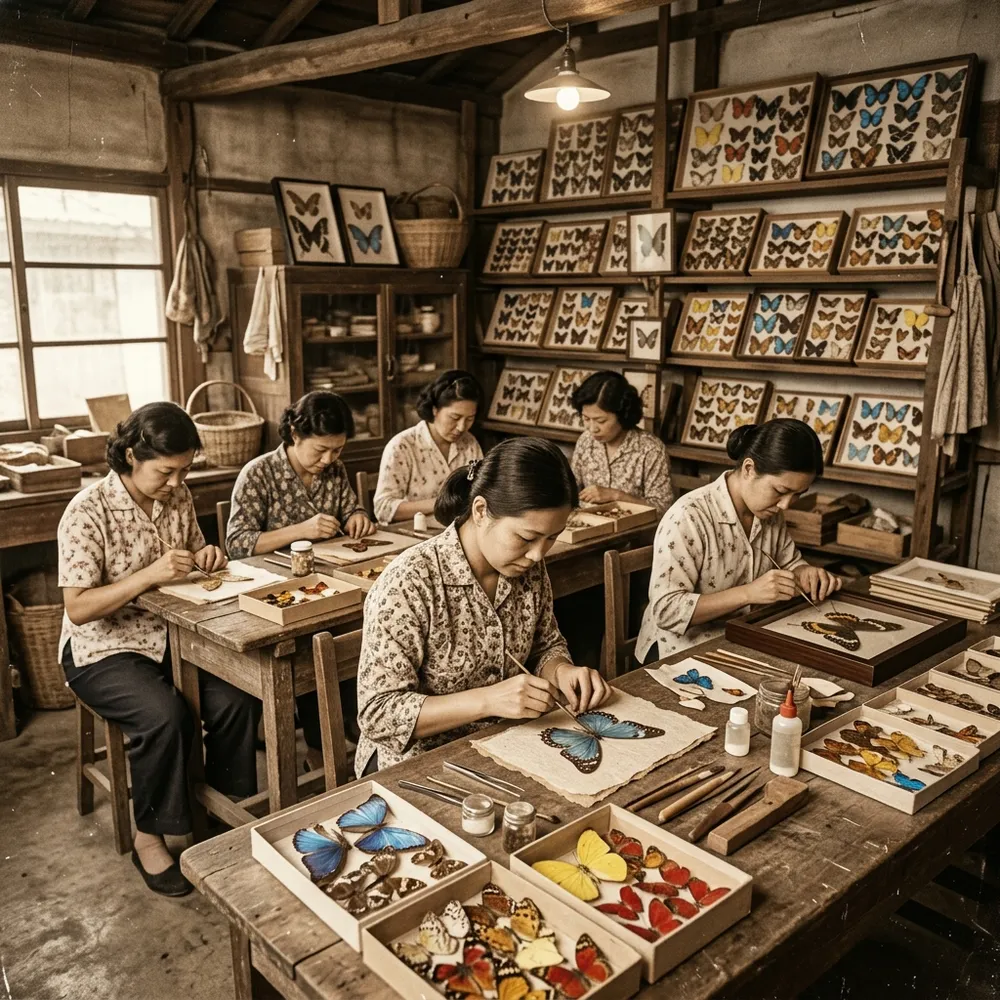 Puli’s rich early ecology and butterfly collecting cultivated a workforce of patient, skilled painting artisans
In the postwar years, Taiwan’s forestry industry flourished. Sitting at the center of a basin surrounded by rich forest resources, Puli saw as many as 46 registered logging operations, lumber yards, and sawmills (such as Lin Chuan-fa Sawmill) between 1941 and 1970, establishing a decisive raw-material advantage.
The proliferation of sawmills made it easy for woodware makers to source local timber such as Taiwan incense cedar, camphor, and Schefflera (duck-foot tree), creating an excellent local competitive edge in transport and processing costs. The sound of sawing and business dealings at night made Puli’s streets feel like a city that never slept.
Behind this thriving forestry sector stood Nanxing Street ("Blacksmith Street") — a truly critical iron backbone. In the early Japanese colonial period, blacksmith shops were forcibly relocated by Japanese police to a vacant lot behind Hengji Temple (a Mazu temple) due to heat and safety concerns. At its peak, Blacksmith Street was home to more than 30 forges (such as Hsinhsing Forge), crafting high-quality giant saw blades, machetes, and turning chisels for the forestry and lathe-turning trades. Blacksmiths there still follow the tradition of "resting on the 16th day of the lunar month," reflecting a distinctly folk-artisan wisdom for physical recovery.
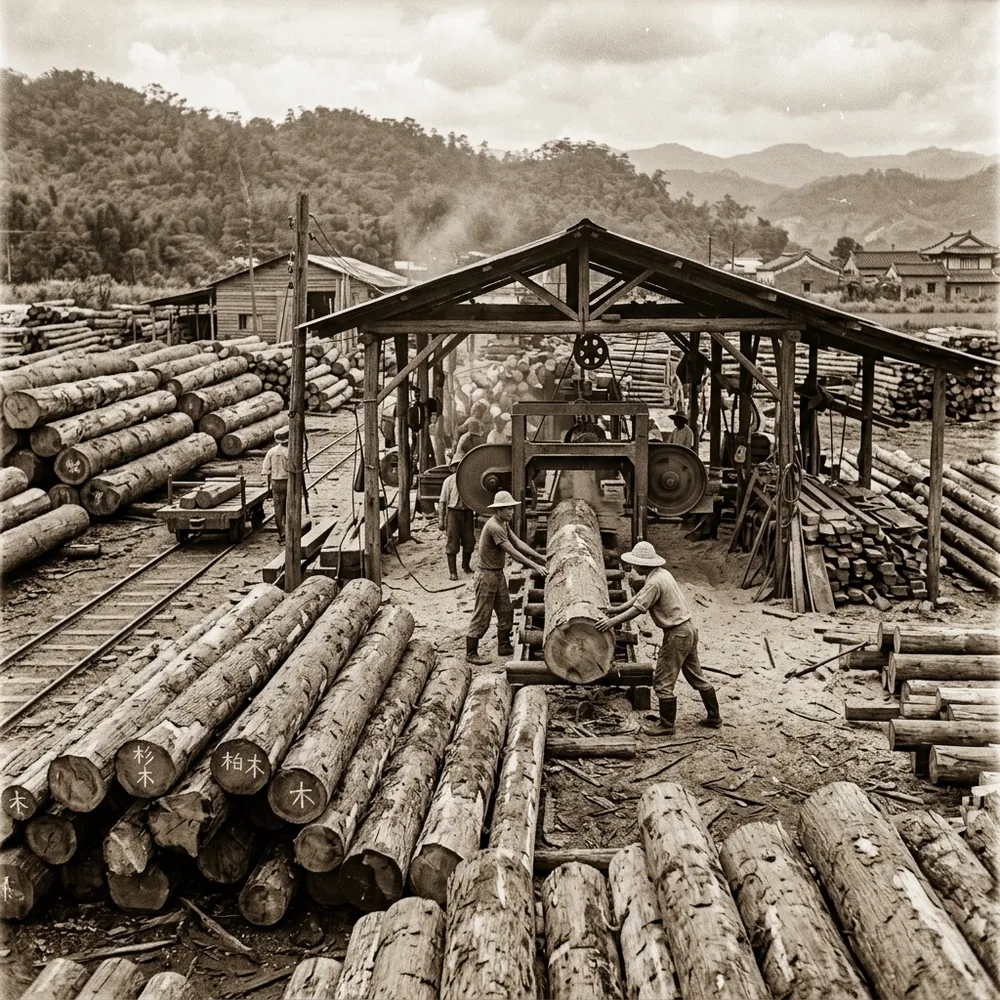 The mountains surrounding Puli were rich in forestry resources; roughly 40 sawmills once operated here
In 1952, Nantou’s first county magistrate, Lee Kuo-chen, invited the renowned artists Yen Shui-long and Wang Ching-shuang to launch the "Nantou County Specialty Handicraft Workshop" to promote local crafts. This formally introduced wood-lathe turning technology and taught trainees to make toys, wooden bottles, and assembled animal figures — planting the seeds of craft skills in the countryside.
In 1956, the "Taiwan Handicraft Promotion Center" was established. Under US aid technical cooperation, American tourist-handicraft design expert Diana DeRouche was specially invited to Taiwan in 1959 to provide guidance. She introduced Western festive styles such as "Christmas tree ornaments" and "artificial flower dolls," directly connecting Puli’s home-based handicraft industry with the European and American export markets and igniting the engine of export manufacturing.
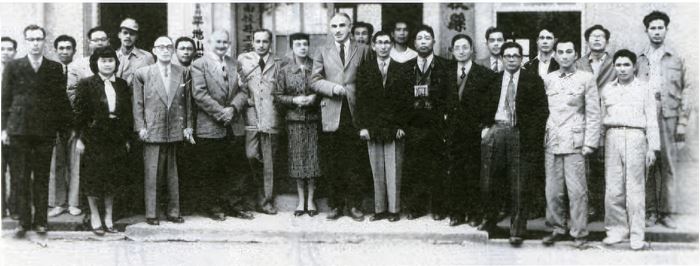 A December 1955 photo from an inspection visit to the Nantou County craft research class
As the "living room as factory" policy took hold in the 1970s, Puli’s export manufacturing reached its peak, with more than 400 registered craft factories in total. Kokomu’s predecessor — "Haishan Industrial Co." — was founded on May 1, 1974, by Mr. Shih Kun-hai together with his two younger brothers.
Haishan Industrial initially made flat wine racks and picture frames on contract, before creating a legend in the music box field. Its most famous creation was the patented "book-style music box": opening the exquisite, Bible-like wooden box would trigger a moving wind-up melody as three-dimensional Christmas figures slowly turned. This signature piece was deeply loved in European and American markets, and orders never stopped year-round. At its peak, the factory employed as many as 70 workers on ordinary days — topping 100 during the summer — writing a glorious chapter in Puli’s history as the "Wooden Toy Kingdom."
During this golden age of full community mobilization, Puli locals affectionately called these exquisite three-dimensional Christmas figures "âng-á," and developed classic slang terms such as "gluing âng-á" (âng-á-liâm, assembling parts) and "painting âng-á" (âng-á-uē, coloring and detailing) — with people of all ages working late into the night in brightly lit living rooms. Among the pieces, the hardest to manufacture was the traditional German "Christmas pyramid" ornament (locally nicknamed the "candle windmill"), whose mechanism relies on the rising heat convection of burning candles to spin the blades on top — demanding an exacting, zero-tolerance precision in the lathe-turned parts’ symmetry and balance.
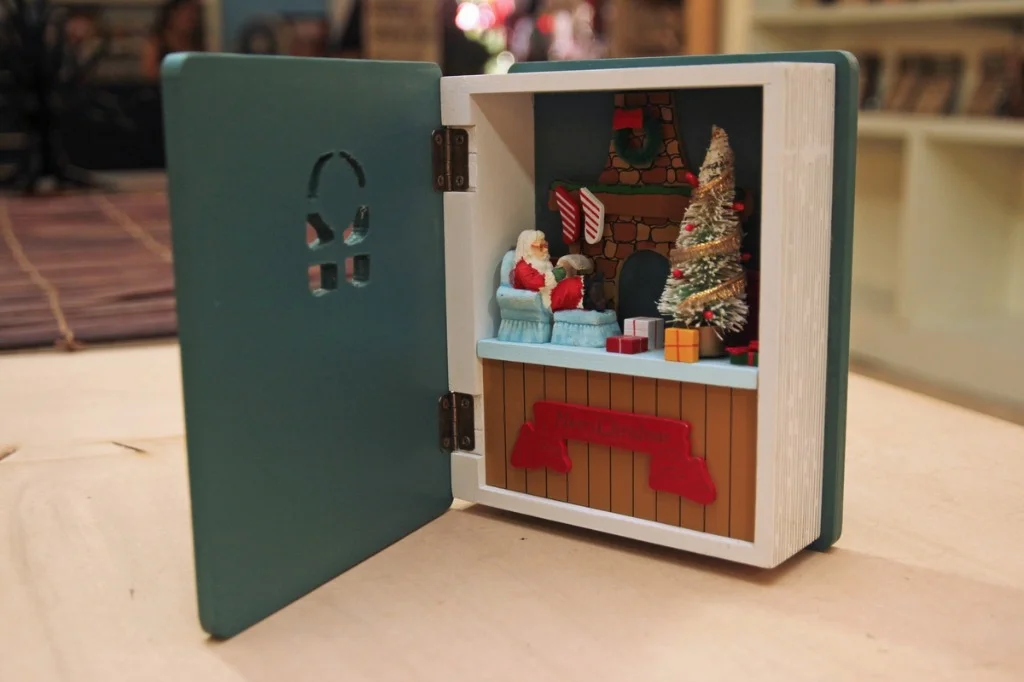 Open the exquisite, Bible-like patented "book-style music box" to reveal a cozy fireplace and Christmas scene inside
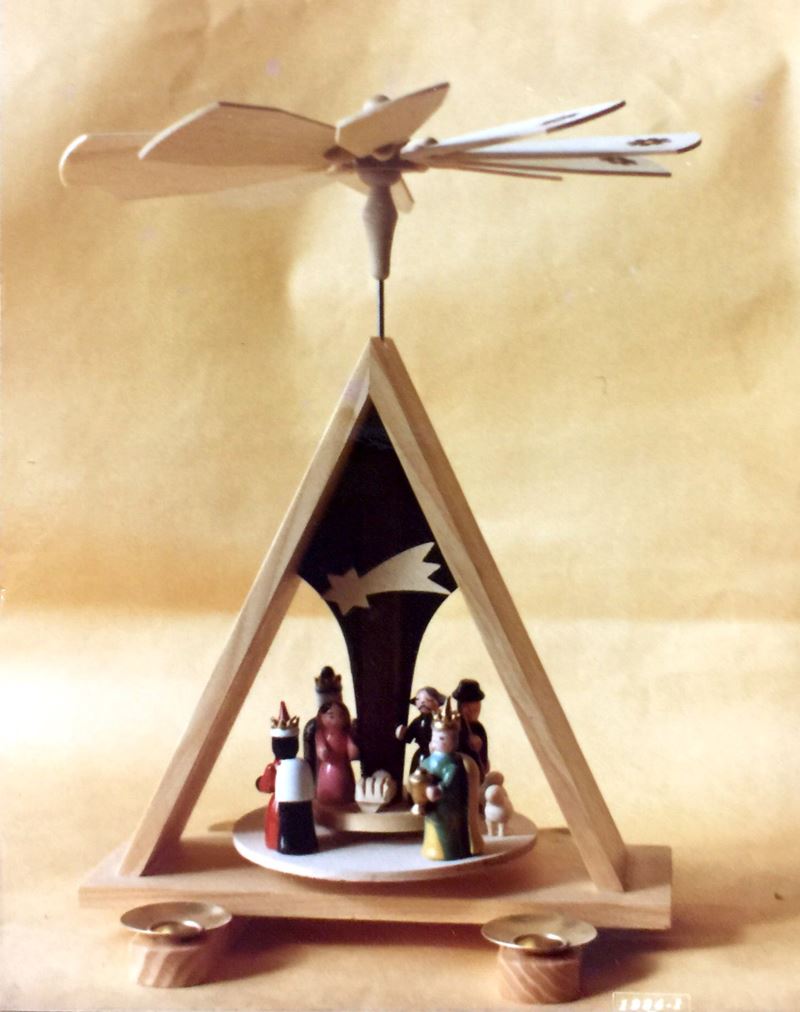 A classic German-style "Christmas pyramid" manufactured for export by Haishan
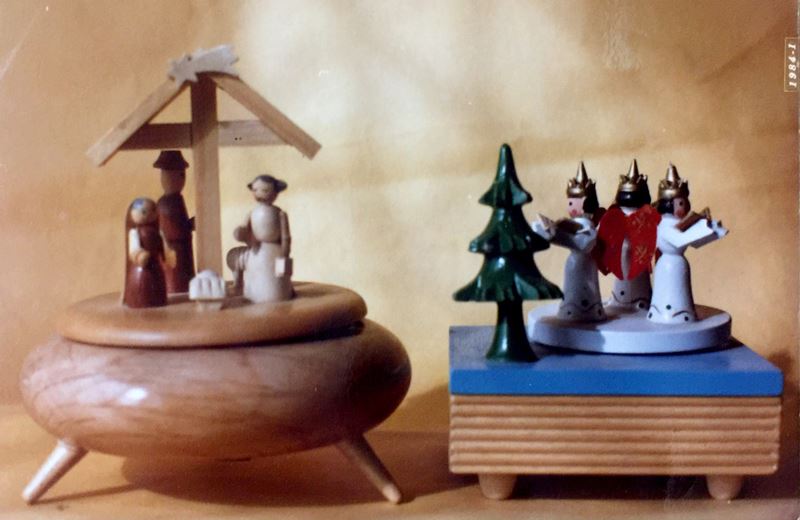 A classic music box featuring the patented book structure and a Sankyo movement
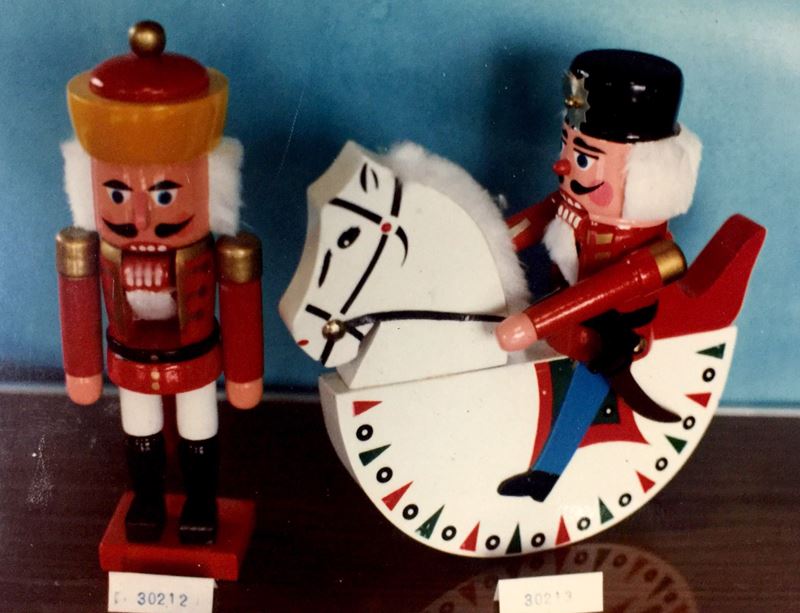 A classic handmade nutcracker figure exported to festive markets in Europe and America
Early export manufacturing was full of challenges. Puli’s craftsmen used creativity and mechanical ingenuity in modest conditions to develop many remarkable "signature techniques and know-how." (Hover over a card to flip it and see the details)
Parts for export toys were extremely tiny — a "rabbit ear," for instance, was only 0.3 cm wide and 2 cm long. Without high-precision imported machinery, how did Puli’s craftsmen cut tens of thousands of perfectly uniform ears?
Master turner Chen Wan-fa and a local ironworks developed a patented compound blade and modular saw set that could precisely split a rabbit-ear rod — just 0.3 cm thick with two pointed ends — exactly in half. It could even cut the intricate shape of a lion’s nose in a single pass. This invention boosted daily output from dozens to tens of thousands of pieces, astonishing trading partners.
The soul of a Christmas doll or nutcracker soldier lies in its delicate cheeks. Hand-painted blush in the early days often had hard, unnatural edges — so how did they achieve a perfectly gradated, rosy blush?
To solve the problem of hard-edged painting, the Shih brothers looked to beauty salons for inspiration and bought "miniature airbrushes" used for cosmetic spraying, converting them into painting tools. The extremely fine nozzle perfectly rendered a gradated rosy blush and delicate shading on the dolls’ faces, becoming Haishan’s core painting technique.
When exporting music snow globes to cold climates, the biggest challenges were cracking from freezing, cloudy water, and peeling paint on the figures inside. How did Haishan overcome these technical hurdles?
After the figures inside a snow globe were assembled, they had to be soaked in high-concentration soda water to open the wood’s pores and prevent paint from flaking. When filling the globes, tap water was abandoned in favor of "well water," and a machine was used to extract the oxygen from the water, sealing it into the glass globe in a near-vacuum state along with anti-freeze additives — ensuring the globe wouldn’t freeze or bubble in cold temperatures.
Behind Puli’s export miracle was a micro-ecosystem made up of hundreds of specialized subcontractors and households. High-speed lathes turned wood into spheres and cones, which were combined through an extraordinarily fine-grained local home-piecework division of labor (known as "gluing âng-á" and "painting âng-á") to assemble dozens of wooden parts into lifelike Christmas figures.
 Doll parts, paint, white glue, and painting tools (illustrative image with background removed)
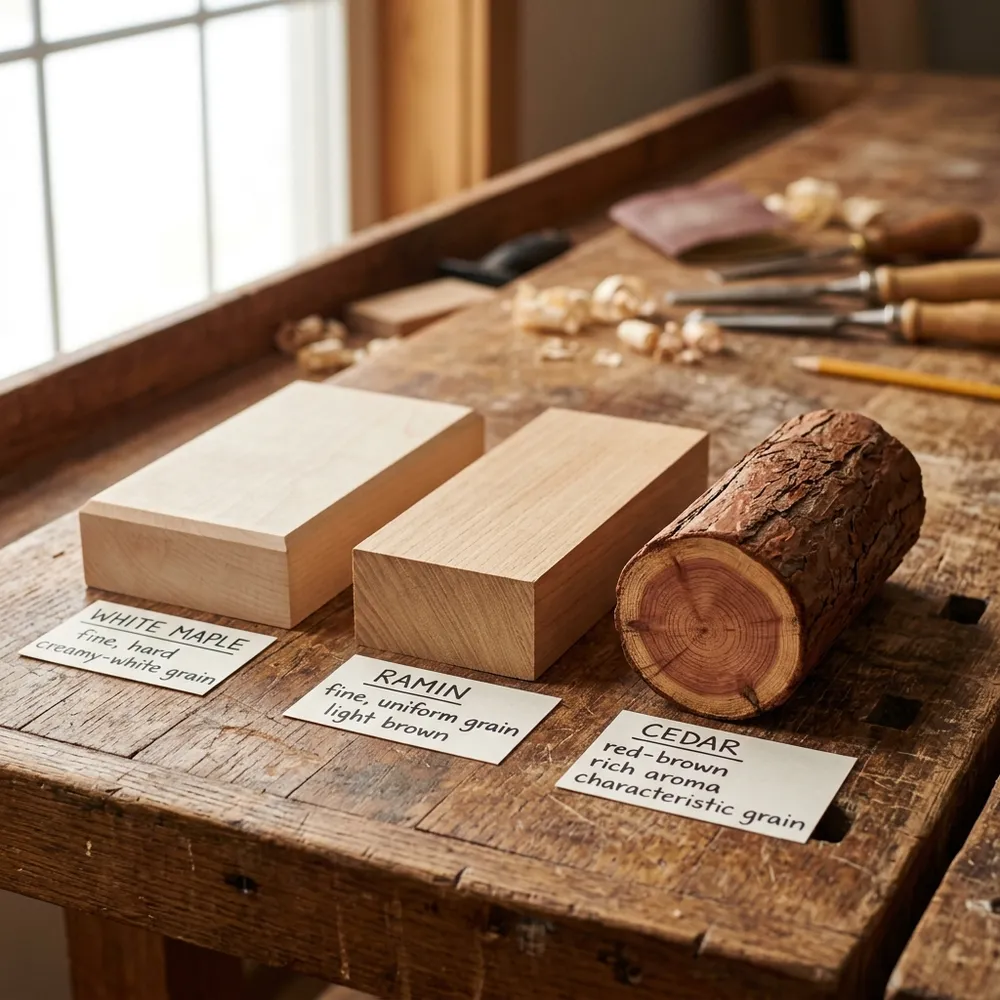
A long wooden rod (early on, local mixed woods such as Machilus and Schefflera; later switched entirely to imported white wood such as Ramin during the export peak) was mounted on a lathe and spun at high speed, with a hand-held turning tool shaping a rough round or oval head and body.
The turned wooden pieces were sent to specialized drilling workshops for precision drilling based on each toy character’s pose and angle, increasing the bonding surface for later assembly and fixing the figure’s lively posture.
Subcontractors distributed the parts to individual households, where residents used Nan Pao resin (white glue) to bond the wooden torso, limbs, base, and fine components (such as rabbit ears and lion noses) according to a template — often involving more than a dozen gluing steps.
The glued figures were mounted in rows on special steel pins and dipped, tray and all, into a primer cement paint to seal the wood grain’s pores and prevent future cracking. After air-drying, they were dipped in a second coat of colored paint as the figure’s base color.
The pieces returned to the painting workshop for facial features and coloring. Eyes and buttons were never painted with a brush, but hand-dabbed with small round bamboo sticks of varying diameters in a "dot" technique to prevent bleeding; Santa’s rosy cheeks were finished with the salon-style miniature airbrush for delicate, gradated shading.
Households attached a metal ring with gold thread to the figure’s head for hanging, applied the classic "MADE IN TAIWAN" label to the base, and completed final packing, bagging, and boxing before shipment to port — bound for holiday markets across the US and West Germany.
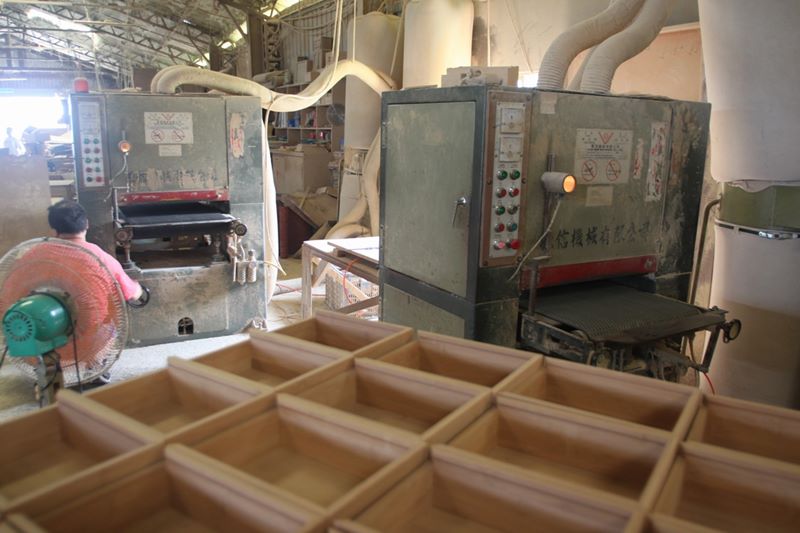
As resource supply and environmental policy shifted, Puli’s handicraft industry went through several rounds of upgrades in timber, lathe, and printing technology.
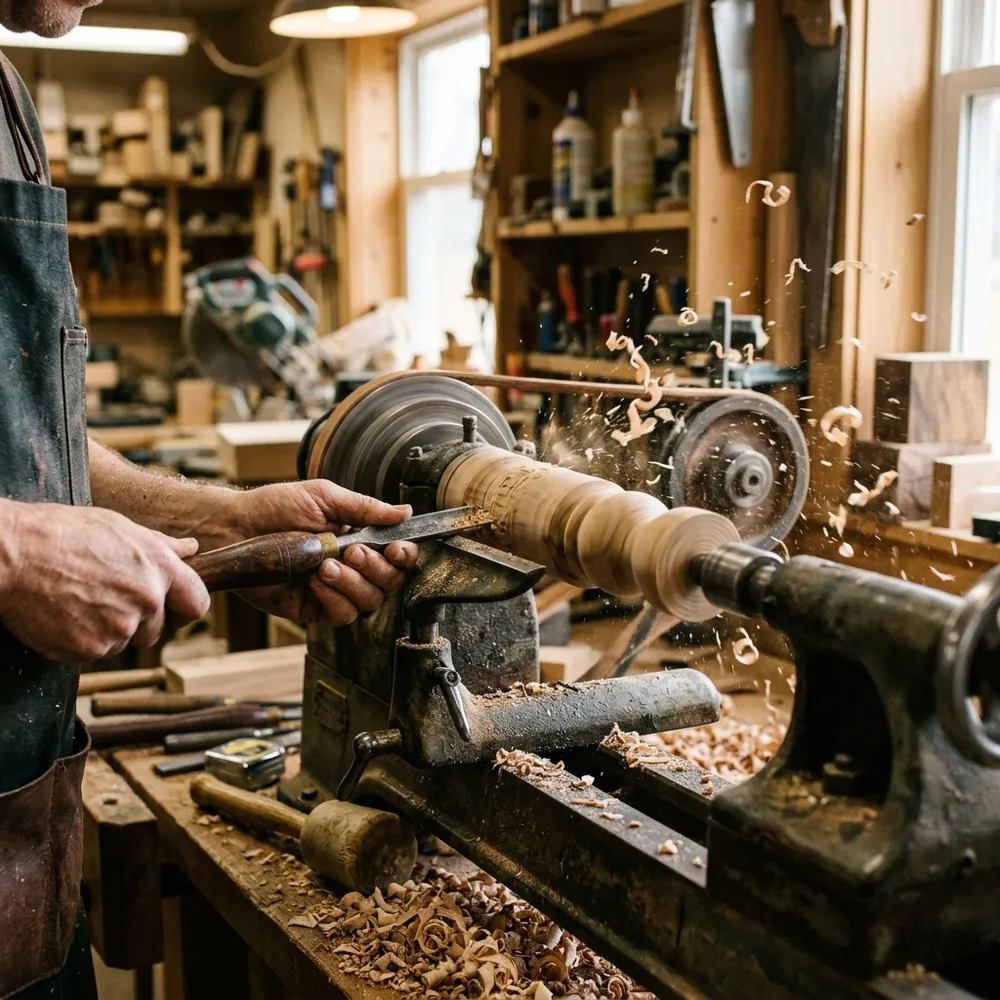
Even the brightest golden age couldn’t withstand the dramatic shifts of the times. In the late 1980s, multiple factors converged, forcing this mountain-town "Christmas empire" into decline.
After the 921 Earthquake and industry hollowing-out, Puli’s woodcraft split into two paths: a handful of factories stayed and pivoted toward tourism, while other artisans used post-disaster cypress and banyan driftwood to turn high-value artistic vessels and wooden bottles, pioneering a more refined craft aesthetic.
In 2012, Haishan’s second generation took up the legacy, upgrading the traditional contract factory into the "Kokomu" tourist workshop — transforming the old craft of making music boxes and nutcrackers into DIY experience products visitors could shape with their own creativity. As visitors wind the key and a bright, cheerful melody rings out, half a century of woodcraft spirit finds new life at their fingertips. By 2026, the latest AI digital design, custom laser engraving, and OMO guided tours have been introduced, opening a new digital chapter for this wood craft.
 The old factory has been transformed for a new era into the Kokomu experience space, filled with laughter
According to official statistics, from the 1940s through 2012, Puli accumulated as many as 592 officially registered woodware, handicraft, and sawmill businesses. Below is the number of newly registered factories by period, along with the historical context.
| Period (CE) | New Handicraft & Toy Factories | New Sawmills & Lumber Yards | Historical Characteristics & Background |
|---|---|---|---|
| 1941 – 1970 | 44 | 46 | Foundation era: Postwar wooden clogs and everyday wooden goods took off; craft training workshops introduced lathe turning, and US-aid-driven Western-style Christmas toy exports began. |
| 1971 – 1980 | 115 | 22 | Boom era: The "living room as factory" movement took off; orders for Christmas ornaments and music boxes poured in, and Puli rose to become the world’s "Christmas City." |
| 1981 – 1987 | 219 | (merged into imports) | Historical peak: 219 new registrations in 7 years; 80% of all wooden Christmas ornaments in the US were made in Puli, and the town was awash in prosperity. |
| 1988 – 2012 | 136 | 10 | Transition and offshoring era: NT dollar appreciation, logging bans, and the Labor Standards Act pushed many factories to move west to China; those who stayed pivoted to hands-on DIY and refined craft. |
Follow the timeline to relive a century of Puli woodcraft, from butterfly specimens to the integration of AI and OMO digital experiences.
Puli pioneers the butterfly collection and specimen-processing trade, building a finely woven local piecework and painting-women’s network.
Despite a postwar economic slump, forestry flourishes; as many as 46 registered logging operations and sawmills spring up in Puli, establishing a strong material-cost advantage.
Nantou County Magistrate Lee Kuo-chen invites master artists Yen Shui-long and Wang Ching-shuang to found a craft training workshop, formally introducing wood-lathe turning technology.
Under US aid technical cooperation, American design expert Diana DeRouche is brought in to guide the development of Western-style Christmas ornaments, breaking into Western export markets.
Taiwan’s butterfly exports rank first in the world. The same year, Fengyuan introduces Japanese Aizu-style lathes, training a large pool of precision-turning talent that later flows into Puli.
Puli woodware makers introduce semi-automatic lathes from Fengyuan, formally kicking off lathe-turned export manufacturing.
Haishan Industrial Co. is formally founded on May 1; the three Shih brothers focus on contract turning, flat wine racks, and picture frames, later specializing in music boxes.
Lathes evolve into fully automatic high-speed models; screen printing adopts the "tracing and plate-making" method, markedly improving efficiency.
Screen printing is upgraded to the "photosensitive plate-making" method, enabling richly detailed, multi-color Christmas artwork on mass-produced flat wooden ornaments.
Haishan Industrial mass-produces the patented "book-style music box" and "snow globe music box," becoming a pioneer of Taiwan-made wooden toys and music box exports.
The company transforms into the "Kokomu" tourist workshop, opening its doors to hands-on craft experiences and carrying forward half a century of wood-craft-town memory through design and culture.
The latest integration of AI custom design and the OMO online-to-offline points and stamp-collecting program launches, opening a new digital generation of woodcraft.
Optimized for AI search engines and voice search, offering precise, authoritative answers about Puli’s woodcraft industry.
Puli’s handicraft network originated with the butterfly collection and specimen-processing industry that developed starting in 1918. This butterfly industry cultivated a dense "cottage industry network" in Puli along with a large pool of skilled hand-painting women. After the butterfly industry declined in the early 1970s, this experienced painting and hand-assembly workforce quickly shifted to wood-product manufacturing, becoming the key technical foundation for the later takeoff of woodware and music box exports.
In 1952, Nantou County Magistrate Lee Kuo-chen invited master artists Yen Shui-long and Wang Ching-shuang to found the "Nantou County Specialty Handicraft Workshop," introducing wood-lathe turning technology for the first time and sowing the seeds of turning talent in the countryside. In 1959, under US aid guidance, American design expert Diana DeRouche was hired to guide the development of Western-style "Christmas tree ornaments" and "artificial flower dolls," directly connecting Puli’s wooden handicraft industry with European and American festive markets.
Kokomu’s predecessor was "Haishan Industrial Co.," founded on May 1, 1974, by the three Shih brothers, led by Shih Kun-hai. Haishan independently developed the patented "book-style music box" and broke through with a "vacuum degassing and anti-freeze technique" for snow globes, using well water and a vacuum machine to solve the problems of freezing and bubbling or paint peeling in cold climates — successfully making Taiwan-made music boxes a recognized name in Western markets.
Puli’s craftsmen showed remarkable creativity under difficult conditions: (1) Splitting rabbit ears in half: Master craftsman Chen Wan-fa and a local ironworks developed a compound saw die to precisely split 0.3cm x 2cm doll ears, boosting efficiency a hundredfold; (2) The beauty salon airbrush: A converted cosmetic airbrush was used to paint soft, natural blush gradients on the dolls; (3) Physical drum polishing: Semi-finished doll pieces were mixed with large amounts of wood shavings and tumbled in a drum to achieve safe, smooth, burr-free finishing.
The historical facts, industry statistics, and technique descriptions on this page are grounded in rigorous academic research, cross-verified against the following publications and academic theses:
Li Chun-chen, 2012, master’s thesis, Department of Industrial Design, Chaoyang University of Technology. The core historical facts, lathe-turning and screen-printing process diagrams, and factory registration data in this feature are all verified against this thesis.
Chu-ko Cheng, 2005, academic thesis, Graduate Institute of Design, Chaoyang University of Technology. A detailed account of the "Taiwan Handicraft Promotion Center" during the US-aid era and export expert Diana DeRouche’s guidance of Taiwan’s toy and Christmas-goods industry.
Chen Fang-ying, 2004, a survey commissioned by Puli Township Office. A detailed field survey and revitalization recommendations covering the decline and offshoring of Puli’s handmade paper, butterfly, and woodcraft industries after the 921 Earthquake.
Chang Chen-jung, 2007, master’s thesis, Graduate Institute of Design, Da-Yeh University. A detailed study of the historical evolution of the blacksmith community on Puli’s Nanxing Street, the introduction of blacksmithing tools, and their close ties to early forestry logging tools.
Ministry of Culture, Republic of China, National Memory of Taiwan. Documents how, during the Japanese colonial era, police authorities forcibly relocated existing blacksmith shops to a vacant lot behind Hengji Temple (a Mazu temple) to improve the townscape and control bladed-weapon tools.
